The dives
A dive is a microscope that zooms from the body down into one part of it: first the tissue, then the cells, and for one of them the molecules. Five conditions have one, and they're the ones with a Dive badge in the case: Rheumatoid Arthritis, Hashimoto's Disease, Mast Cell Activation Syndrome, POTS and Iron Deficiency.
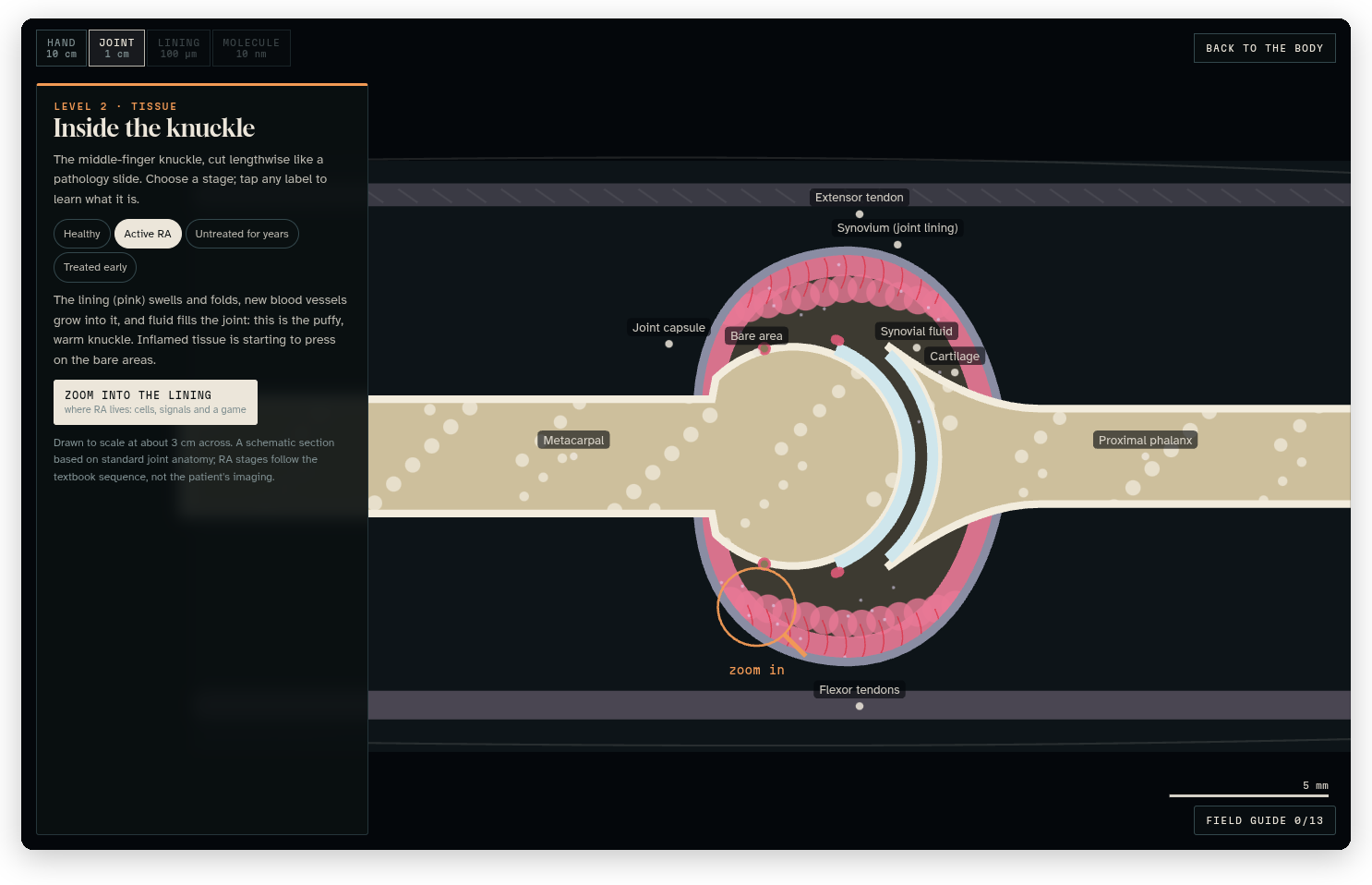 Inside the knuckle: the middle-finger joint cut lengthwise like a pathology slide, in the "Active RA" stage.
Starting one
Open a condition with a dive, go to its Dive tab, which lists the levels and what you'll do at each one, and press Start the dive. The camera flies to the spot on the body first (the knuckle, the thyroid, the forearm, the neck or the duodenum), and then the microscope opens over it.
Finding your way
Along the top are the levels as a scale, from the body part you started on down to the smallest level, each with its size ("Joint, 1 cm", "Lining, 100 µm", "Molecule, 10 nm"). You go deeper with the button at the bottom of the card on the left ("Zoom into the lining" and so on), and each level you've reached stays open in the scale, so you can click back to it. The first one, the body part you started on, takes you back out. The card says where you are and what you're looking at, and some levels have stages to compare, like "Healthy", "Active RA", "Untreated for years" and "Treated early".
Back to the body, at the top right, closes the microscope and takes you back to the condition. Escape does the same.
The five dives
| Dive | The levels | What you do |
|---|---|---|
| Rheumatoid Arthritis | The hand, the joint (1 cm), the lining (100 µm), the molecules (10 nm) | Compare a healthy knuckle with active RA, years untreated and treated early. Then, in the lining, catch TNF and IL-6 and use the patient's medicines to protect the bone and cartilage for a year. At the bottom, Humira catches TNF and hydroxychloroquine sits in the lysosome. |
| Hashimoto's Disease | The neck, the tissue (1 mm), one follicle (100 µm) | Look at a stained slide the way a pathologist does, healthy follicles and then years of Hashimoto's. Then run one follicle, the tiny hormone factory, for a year: adjust the levothyroxine, check the labs, and live with TSH's six-week lag. |
| Mast Cell Activation Syndrome | The forearm, the skin (1 mm), one mast cell (20 µm) | Watch histamine make a red spot, a spreading flare, a hive and the itch, and what an antihistamine changes. Then shrink to one mast cell and keep it calm while triggers drift in, and see where cromolyn and the H1 and H2 blockers each act. |
| POTS | The neck, the reflex circuit (1 m), the rhythm game | Follow the reflex that keeps blood in the head when the patient stands, and the four ways it can fall short. Then play it: every heartbeat you catch on time fires a squeeze, ten minutes upright in sixty seconds, with compression, fluids and propranolol to try. |
| Iron Deficiency | The gut, the lining (1 mm), one gut cell | See the villi that absorb iron, then dose one gut cell daily or every other day for two weeks, and see why hepcidin, the lock on the cell's one exit door, changes the math, and what orange juice or coffee do. |
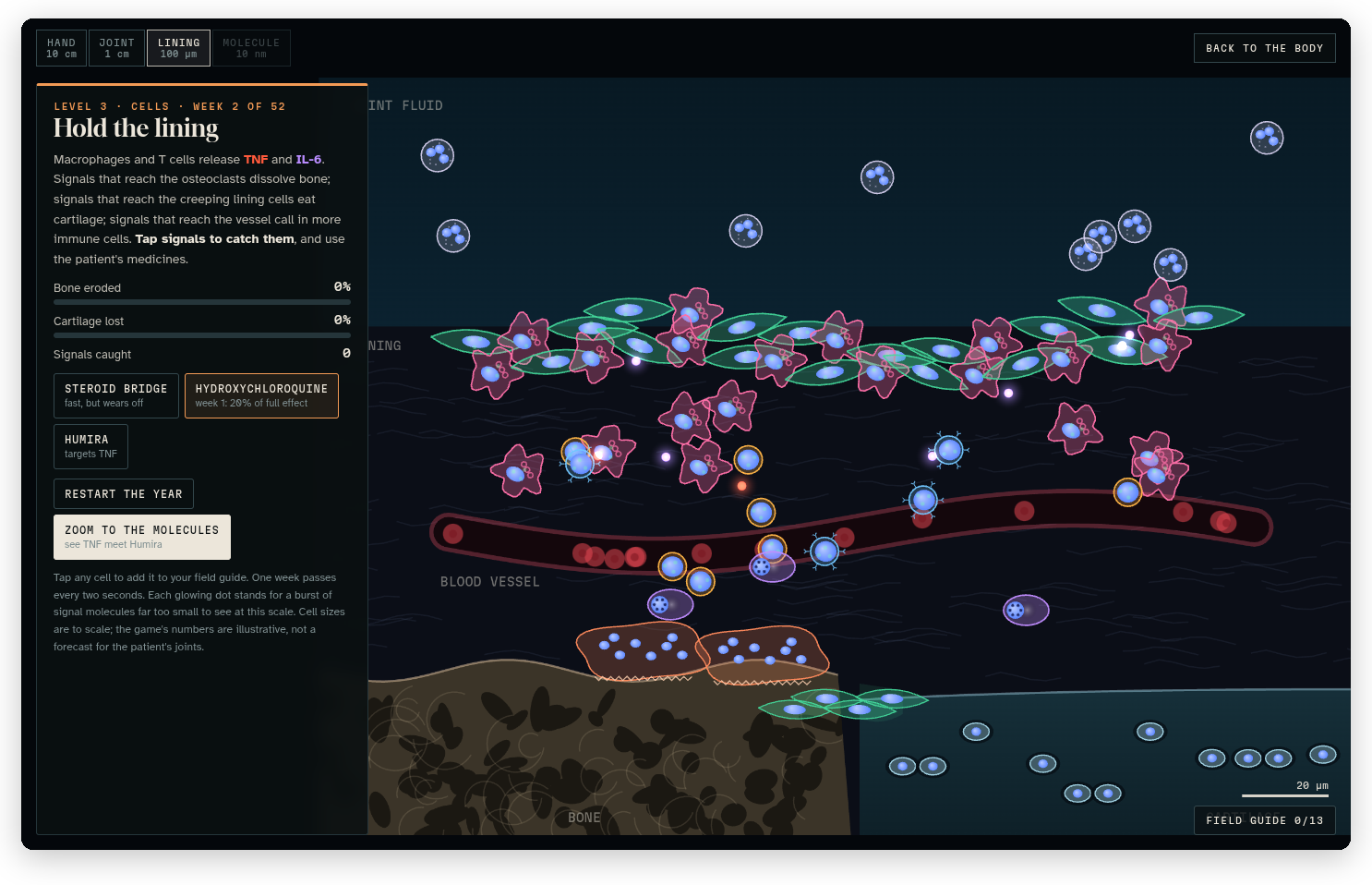 The lining game: the cells to scale, the signals to catch, and the patient's medicines as buttons, with the bone and cartilage counters on the card.
The biology is drawn from published reviews, guidelines and medicine labels. The games' numbers are illustrative, and the card says so where a drawing is schematic and not to scale.
The field guide
Every cell and molecule you tap in a dive goes into the "field guide", with a little drawing and a short note on what it is and what it does. The Field guide button at the bottom right shows how many you've found out of how many there are in that dive, like "Field guide 4/13", and opens the cards. A card you haven't found yet stays blank until you tap that thing in the microscope.
Quiz me, under the cards, shows you one of the drawings and four names to choose from, and keeps the score as you go. Once you've found four or more, it asks about the ones you've found, and a right answer about one you haven't found yet adds it to the guide.
The field guide is kept in your browser, so it's still there the next time, and the Dive tab of each condition counts the entries you've collected across all the dives.
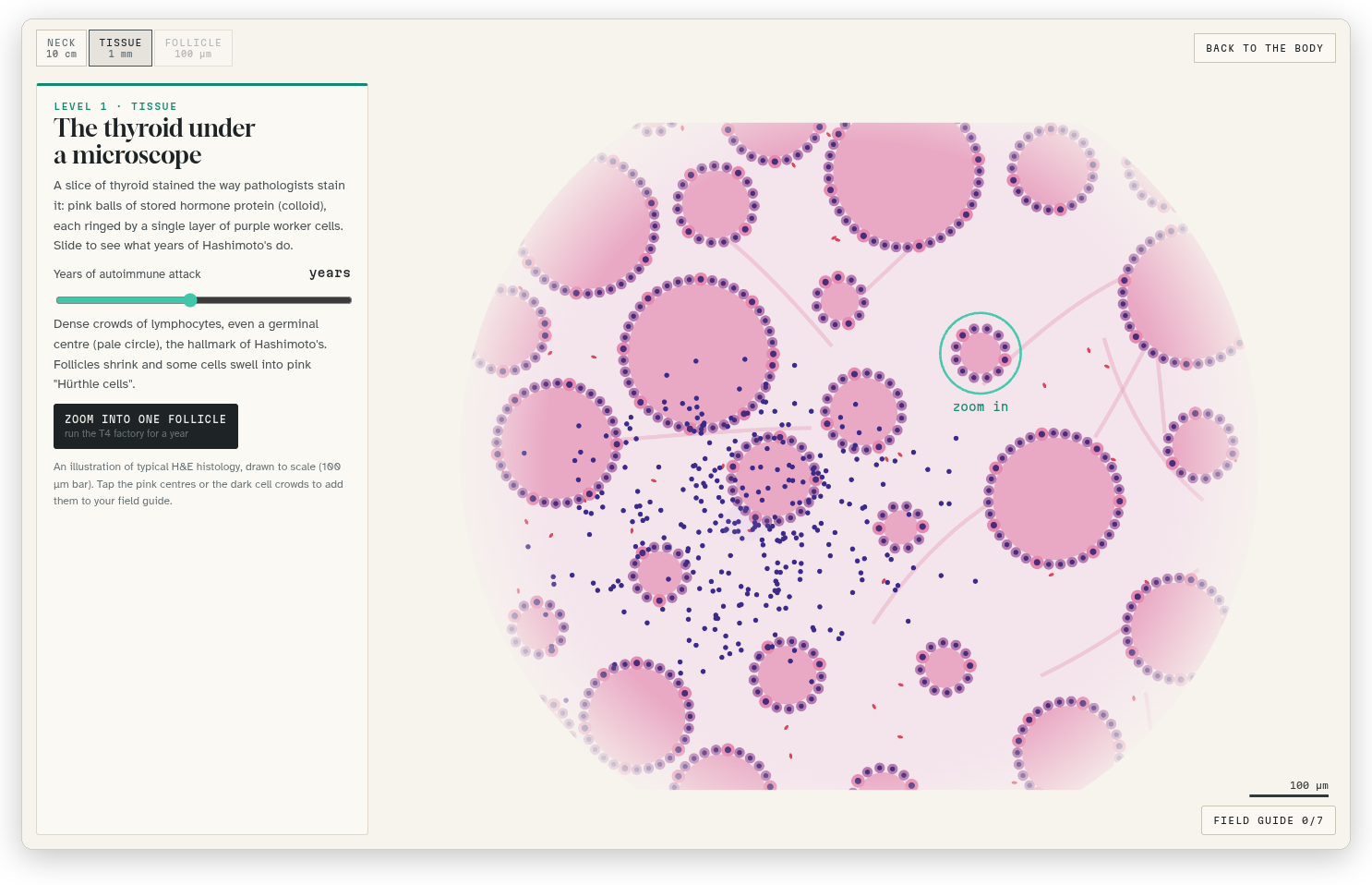 The thyroid dive's stained slide in light mode: the microscope switches to brightfield, and the stain keeps its real colours.