The quiz and the formula sheet
The Mixed quiz is 10 problems from different topics, the closest thing in Med Math to the real exam. The Formula sheet is everything on one card, to read on screen or print. Both are on the home screen and in the bar at the top.
Taking a quiz
A quiz picks 10 problems spread over the topics you've chosen in Settings (the 14 dosage topics unless you've changed it), so you won't get three heparin problems in a row. The row of little tickets at the top shows where you are. The blood gas topics have a quiz of their own, the Blood gas quiz in the Blood gases box on the home screen, and you can also add them to the mixed quiz in Settings.
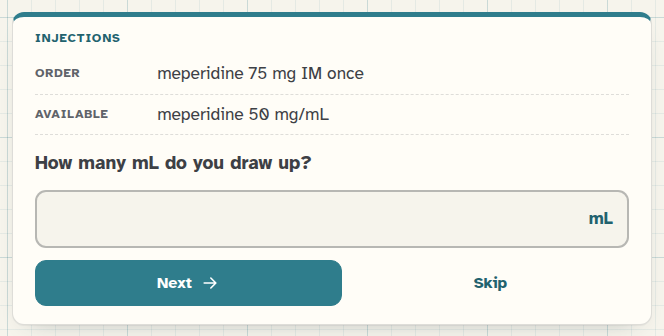 Problem 1 of 10. You'll see how you did at the end.
Unlike practice, the quiz doesn't tell you whether each answer is right as you go, which is how an exam works. Type the answer and press Next (or Enter), and the last one says Finish. Skip moves on without an answer, and a skipped problem counts as a miss. Every answer in a quiz also counts towards your progress for its topic.
The results
At the end you get your score, circled in pencil, and a list of all ten problems with what you answered. The misses have a red cross and the right answer under a highlighter, and every problem, right or wrong, has a Show me that opens its train right there in the list.
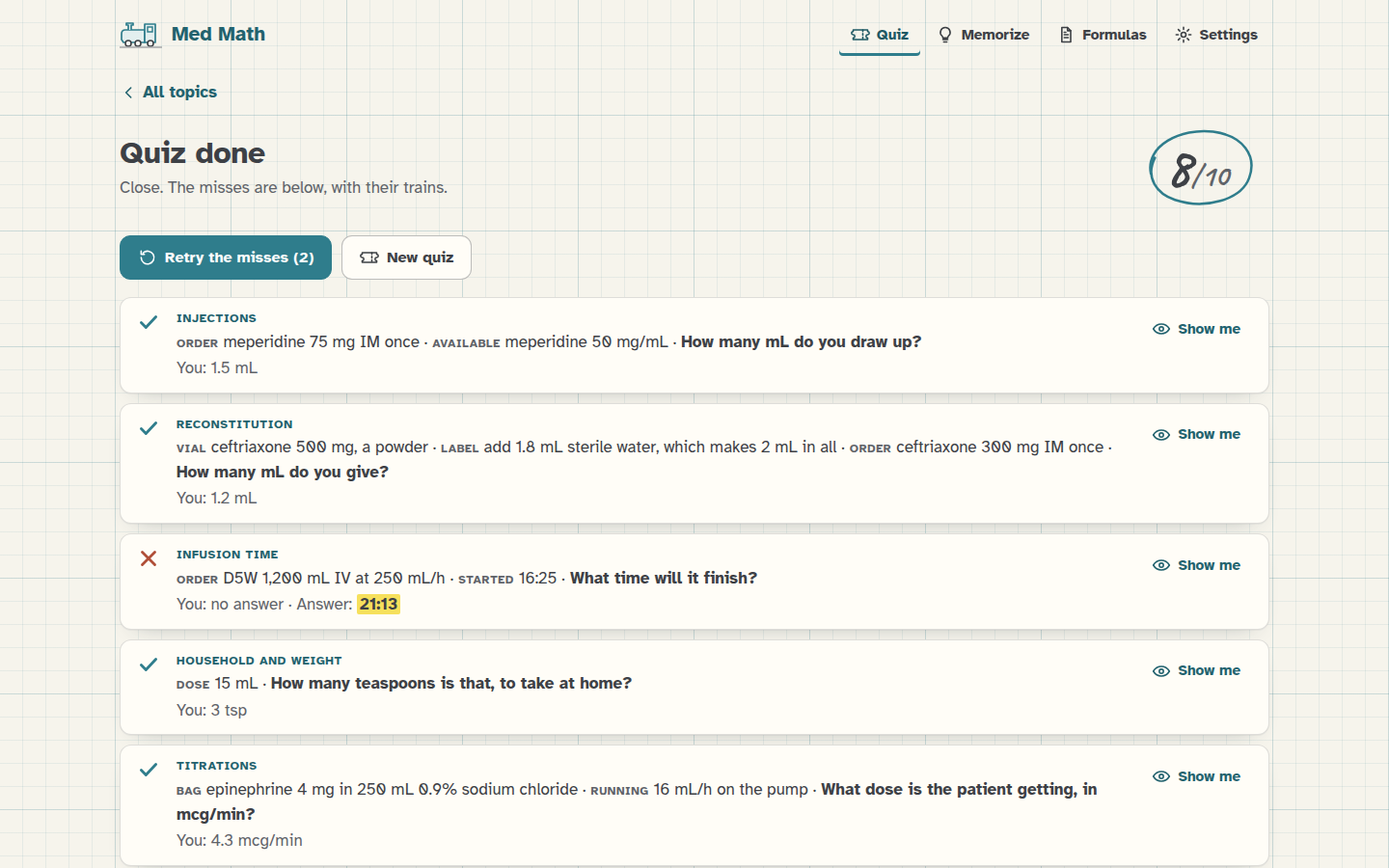 8 out of 10, with the two misses ready to try again.
Retry the misses gives you just the problems you missed, with the same numbers, so you can try them again after looking at the trains. New quiz makes a fresh set of 10.
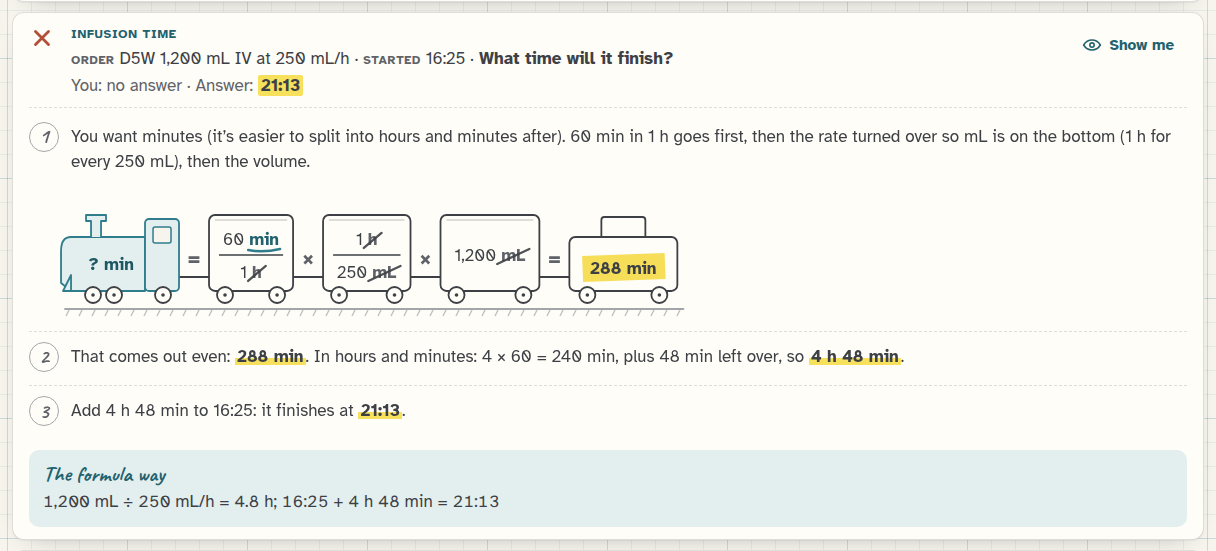 A miss, opened in the results.
The formula sheet
The formula sheet has every formula Med Math uses, written out with proper fractions: the train itself with an example, desired over have, IV pump rates, gravity drips, infusion time, weight-based doses, the safe-dose check, reconstitution, heparin, titrations and BSA. There's a table of conversions, and a card with your own rounding rules, which follows your settings, so if you switch pump rates to whole numbers the sheet says so too. Then the blood gas cards: the normal ranges, reading an ABG (the five steps, tic-tac-toe and ROME), Henderson-Hasselbalch, expected compensation, the anion gap, oxygenation and the P/F ratio, and the plain words for patients. Next to each blood gas formula there's a short memory hook in handwriting, like "one and a half bicarb plus eight, give or take two", and each one links to its card in Memorizing blood gases.
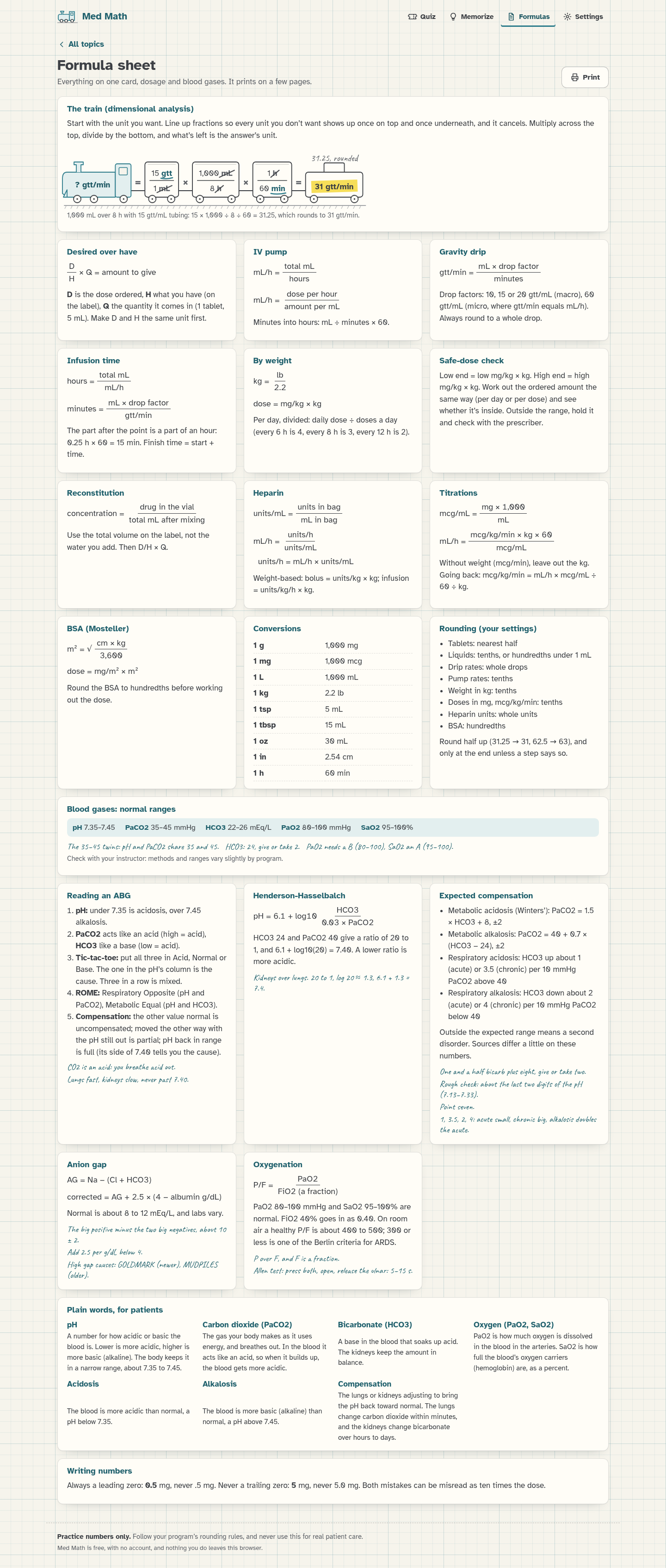 The whole formula sheet.
Print prints it on about four pages, without the buttons and the graph paper, which makes a decent study card to keep in a binder. Basically, it's the cheat sheet you're not allowed to bring to the exam, to learn from before it.
Next step
Take one quiz with all 14 topics on, and then press Retry the misses after you've looked at the trains.