Memorizing blood gases
Most of a blood gas exam is knowing a handful of numbers and formulas cold: the normal ranges, Winters' formula, the anion gap and so on. Working them out doesn't help if you can't remember them, so Med Math has a part just for that, called Memorize it. It's in the Blood gases box on the home screen and in the bar at the top, and it has two halves: memory tricks, and drills to make them stick.
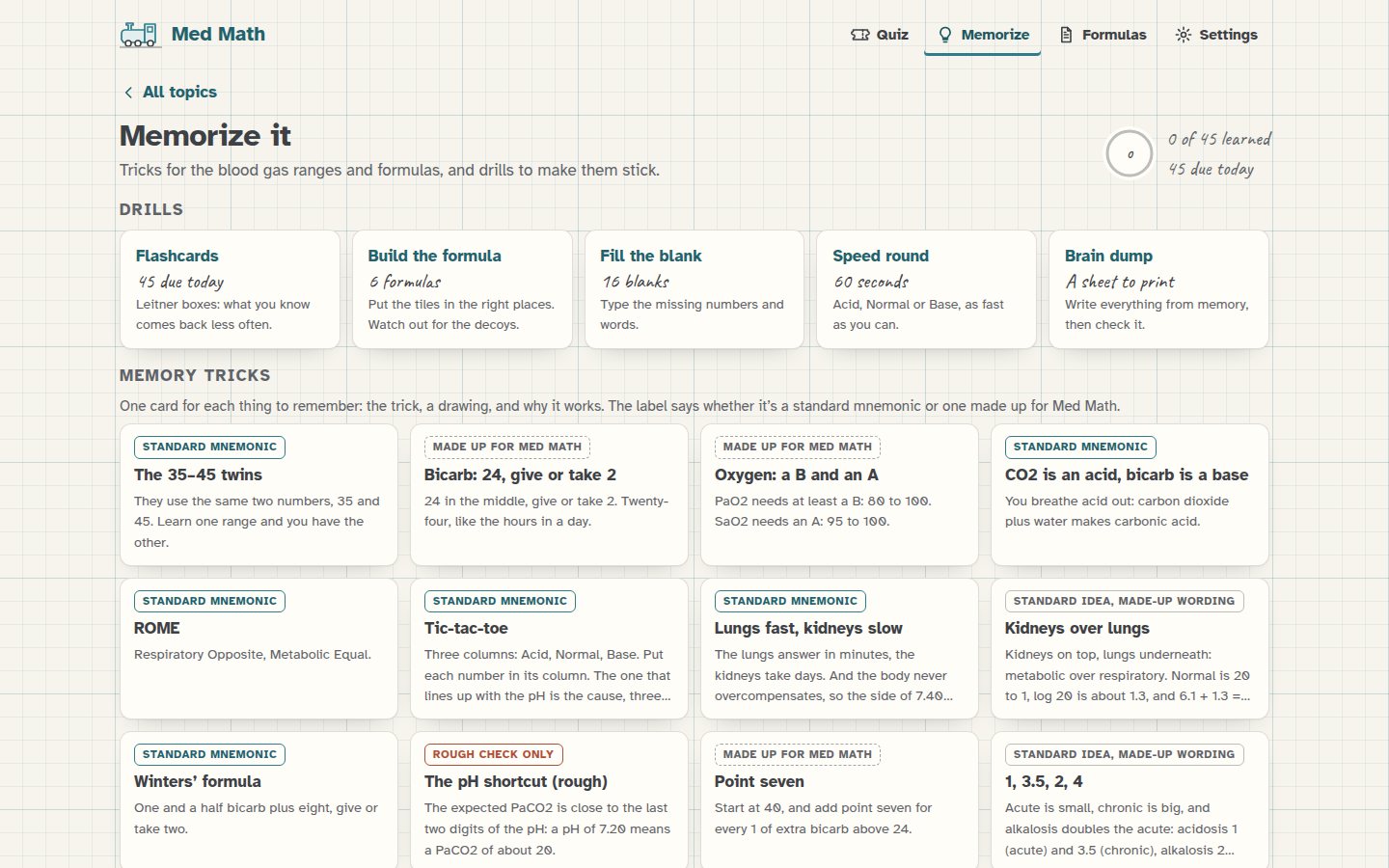 The drills at the top, and one card for each thing to remember underneath.
The memory tricks
There's one card for each thing to remember, eighteen in all: the 35–45 twins, bicarb's 24 give or take 2, the oxygen grades, why CO2 is an acid, ROME, tic-tac-toe, how compensation works, Henderson-Hasselbalch, Winters' formula, the pH shortcut, metabolic alkalosis, the respiratory rules, the anion gap and its albumin correction, MUDPILES, GOLDMARK, the P/F ratio and the Allen test.
Each card has the thing itself, the trick, a small drawing, and a line on WHY the trick works, which is the part I care about most, because a trick you understand is one you don't forget the night before the exam. The drawings aren't decoration either: the oxygen curve is the real curve, and the pH shortcut's chart is worked out from Winters' formula and Henderson-Hasselbalch.
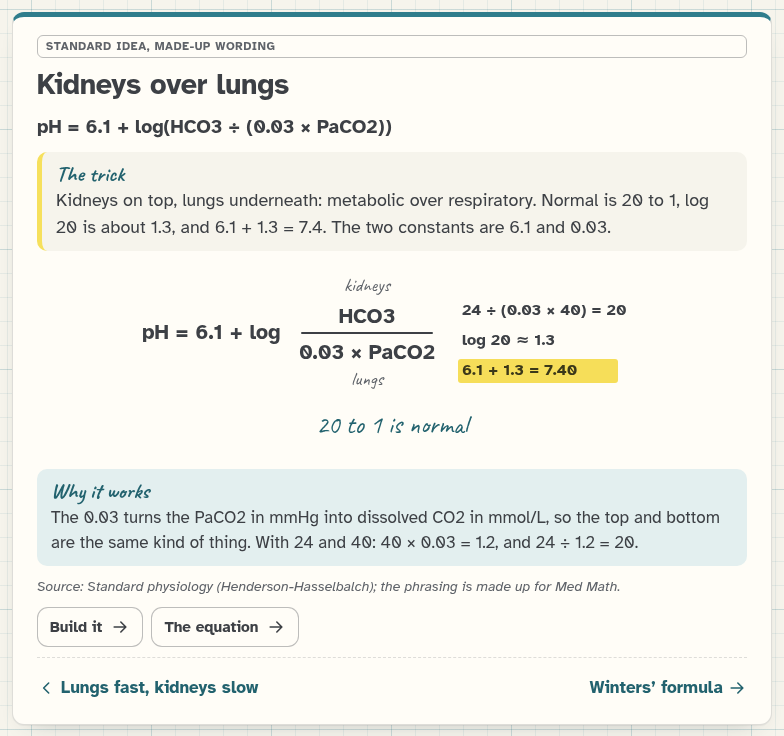 Henderson-Hasselbalch: kidneys on top, lungs underneath, and 20 to 1 is normal.
Every card says what kind of trick it is, so you know what you're memorizing:
- Standard mnemonic is something nursing courses and textbooks teach, like ROME, tic-tac-toe, MUDPILES and GOLDMARK (GOLDMARK is the newer list and the one to learn if your course allows).
- Made up for Med Math is a hook I invented, like "PaO2 needs a B, SaO2 needs an A". The numbers are standard, only the way of remembering them is mine.
- Standard idea, made-up wording is in between.
- Rough check only is the pH shortcut, and it gets its own section below.
From any blood gas problem, Show me ends with a link, "How to remember this", to the trick for that formula, and the formula sheet has a short hook next to each blood gas formula, which links to its card too.
The pH shortcut, honestly
Students often learn that in metabolic acidosis the expected PaCO2 is about the last two digits of the pH, so a pH of 7.25 means a PaCO2 of about 25. I checked it against Winters' formula and Henderson-Hasselbalch, using the pH the way it's written (two decimals), and it's only rough. From pH 7.13 to 7.33 it lands within about 3.5 mmHg of Winters' (the worst is 3.6, around 7.26), and outside that it drifts off fast: about 4.7 mmHg off at 7.10 and 4.3 at 7.34. Funnily enough the classic example, 7.25, is close to where it's worst, so the card uses 7.20 instead. Basically, use Winters' for the answer and the shortcut only to catch a big mistake.
The drills
Flashcards cover every range, formula, constant, rule and mnemonic letter, 45 cards in all. Press Show the answer (or Space), then Got it (G) or Not yet (N). They're sorted into Leitner boxes 1 to 5: a card you get right moves up a box and comes back after 1, 2, 4, 8 and then 16 days, and a card you miss goes back to box 1 and comes round again before the round ends. A card in box 3 or higher counts as learned, and the home screen shows how many you've learned and how many are due today. When nothing is due, Practice all 45 anyway runs the whole deck.
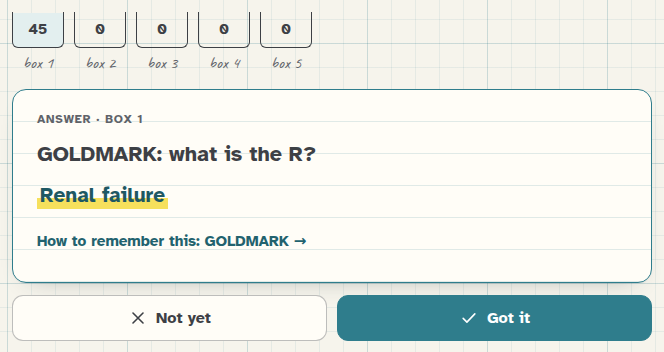 The five boxes, and a card with its answer and the trick that goes with it.
Build the formula gives you the formula with empty slots and a tray of tiles, including a few decoys like 6.4 next to 6.1, or 0.7 next to 1.5. Tap a tile to drop it in the next empty slot, or drag it into a slot, and tap a slot to take a tile back out. It works with a mouse, a finger or the keyboard. There are six: Henderson-Hasselbalch, Winters', metabolic alkalosis, the anion gap, the albumin correction and the P/F ratio. Your answer is checked by working it out at several realistic sets of values and comparing it with what the problems themselves use, which means 0.03 × PaCO2 and PaCO2 × 0.03 both count, but a decoy never does.
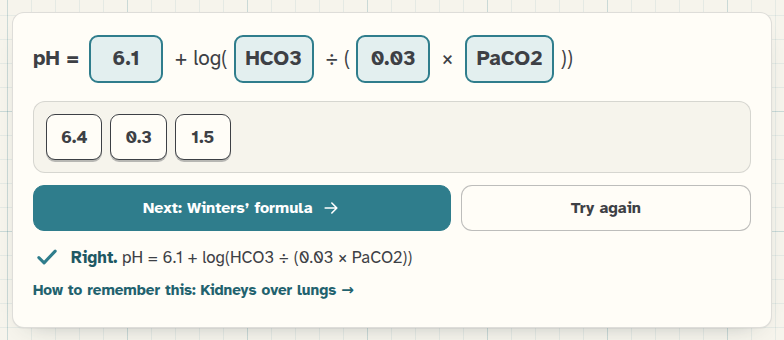 Henderson-Hasselbalch built, and 6.4, 1.5 and 0.3 left behind.
Fill the blank is the same thing typed: "Expected PaCO2 = 1.5 × ___ + ___ ± ___". Numbers can be written any way (.7 or 0.7), and words have a few spellings (HCO3, bicarb, bicarbonate).
Speed round is 60 seconds of single values, a pH, a PaCO2 or an HCO3, and you tap Acid, Normal or Base (or press A, N or B), as many as you can. It's there to make the first step of tic-tac-toe automatic, especially the backwards one: a HIGH PaCO2 is on the acid side. Your best score is saved.
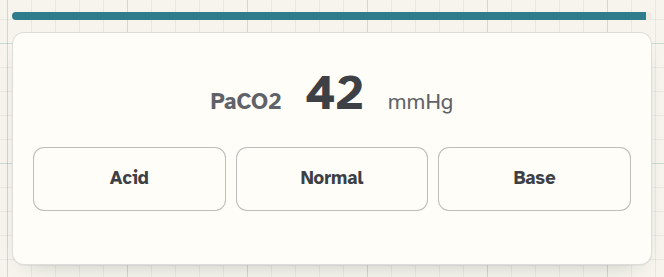 A PaCO2 of 42: inside 35 to 45, so Normal.
Brain dump is a sheet to print, with a box for every range, formula and mnemonic and nothing filled in. A lot of students write all of it down the moment an exam starts, so practicing that habit is worth it. The answer key prints on a page of its own after the sheet.
How sure can you be?
The same as everywhere else in Med Math. Every number on the cards, the tiles, the blanks and the speed round comes from the same place the problems get theirs, and the tests read the numbers back out of the problem functions themselves and check every flashcard, every tile solution (including that no arrangement with a decoy passes), every blank, 3,000 speed-round values and the pH shortcut's numbers above.
Sources
The trick sources are on Blood gases, plus StatPearls ("Allen Test") for the 5 to 15 seconds, and A. N. Mehta, J. B. Emmett and M. Emmett, "GOLD MARK: an anion gap mnemonic for the 21st century", The Lancet 372 (2008), p. 892. ROME, tic-tac-toe, MUDPILES and the 35–45 twins are long-standing teaching mnemonics. REVIEW.md in the repo says which tricks are standard and which I made up.
Next step
Do today's flashcards, then one speed round, and print a brain dump to try at the end of the week.